
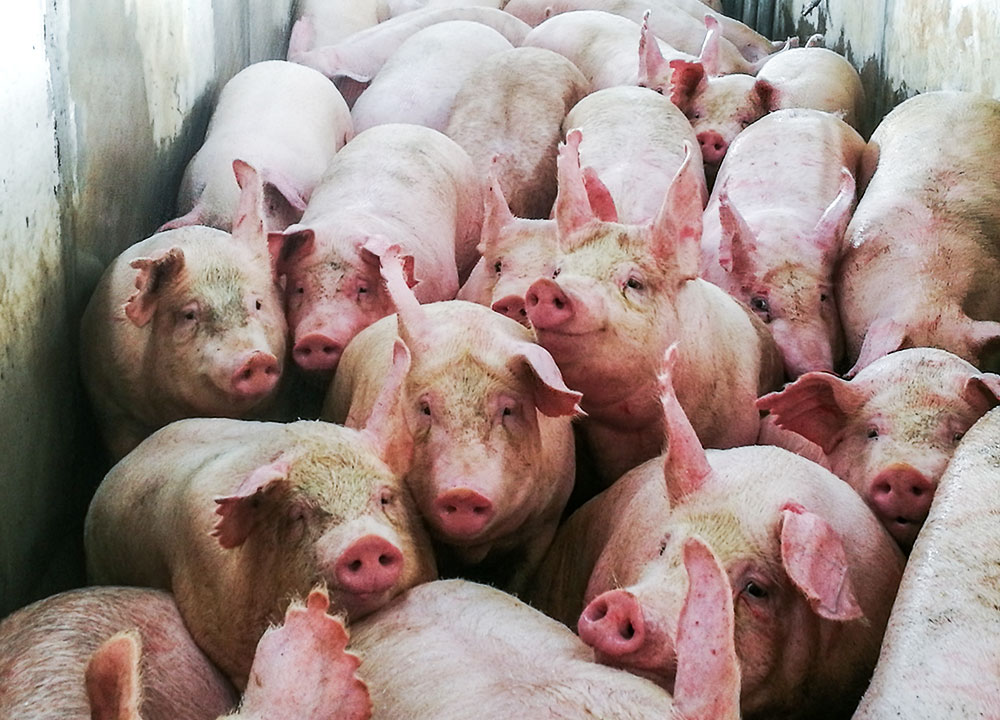
High-concentration CO₂ stunning causes severe suffering to around nine million pigs at slaughter in England and Wales each year. Current slaughter legislation in the UK is a clear case of policy failure; 90% of pigs are stunned/killed with CO₂ and experience up to 30-60 seconds of severe suffering. This is despite slaughter legislation being based on the principle to provide for a humane death, and the British public consistently demonstrating strong preferences for government to legislate to protect the welfare of farmed animals.
Furthermore, labelling schemes, supermarkets, the media and other institutions perpetuate, either directly or indirectly, through commission or omission, the false impression that pigs are killed humanely because they are stunned prior to slaughter. For example, Red Tractor, RSPCA Assured, and Soil Association Organic all do not certify products from non-stunned animals, but do certify products from stunned pigs, 90% of which will have been stunned using CO₂ and therefore will have suffered considerably.
Indeed, the lack of British public awareness of CO₂ killing of pigs is staggering. In a 2020 YouGov poll, only one in 20 respondents were aware that CO₂ is used “a lot” to slaughter animals. A Savanta 2024 poll found that 35% of respondents would not change their consumption habits if they were aware of the suffering CO₂ causes to pigs. But this suggests that around half or more of British consumers would change their purchasing habits. But given that 90% of pigs in England and Wales are killed using high concentration CO₂, such consumers would need to abstain from consuming pork and other pig meat altogether, for their consumption to align with their values.
From both an animal welfare and economic perspective, the inert gas argon is the best alternative to high concentration CO₂ use to stun/kill pigs. Pigs find argon far less aversive, and the time to loss of consciousness is more rapid compared to high concentration CO₂. The PigStun project has demonstrated that argon is a commercially viable alternative, and existing CO₂ slaughterhouses can be retrofitted for argon use. The PigStun project also found that improved electrical stunning, currently carried out in a slaughterhouse in the Netherlands, is another commercially viable option with welfare outcomes superior to high concentration CO₂.
Government policy to permit the use of high-concentration CO₂ means continued suffering at slaughter for around ten million pigs in the UK each year. This is a problem for democratic governance as UK citizens consistently demonstrate supermajority (>67%) support for strong farmed animal welfare legislation. And it is a food transparency and consumer rights problem due to widespread misleading labelling and marketing, ultimately resulting in major market failure in the British pig meat sector.
Recommendations
- Government should act urgently to introduce legislation to ban the use of high-concentration CO₂ stunning/killing of pigs. Given the severe welfare impacts in around 90% of pigs slaughtered in the UK, the method must be phased out within three years, by 2028.
- Legislation in the UK currently requires killing, as well as stunning, of pigs when using gases. Government should amend the relevant legislation to permit pigs to be stunned, and not necessarily killed, to make the use of alternative gases such as argon more feasible.
- Government should provide funding for abattoirs to retrofit slaughterhouses using CO₂ stunning to facilitate the change to inert gases such as argon.
- Government should adopt the recommendations of the National Food Strategy (the 2021 ‘Dimbleby report’) for a 30% reduction in meat consumption by 2032.
- Government should not permit meat from pigs killed using high concentration CO₂ to be labelled as higher welfare, as the practice is clearly misleading to consumers.