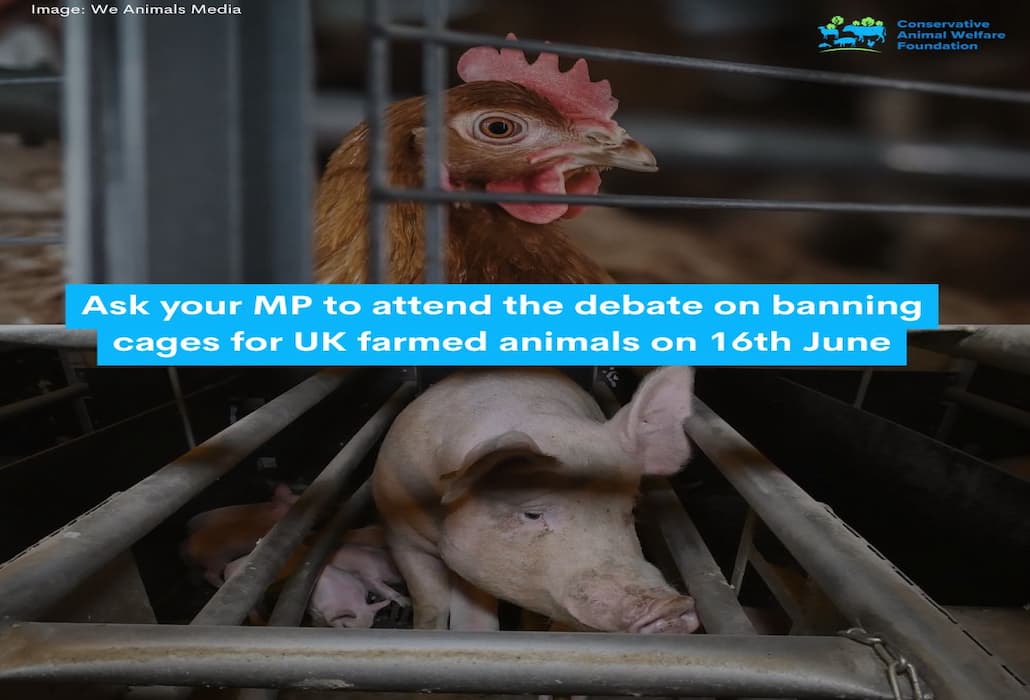
MPs will join a Westminster Hall debate on the use of cages and crates for farmed animals on the 16th June.
Irene Campbell MP, a member of the Petitions Committee, has been asked by the Committee to open the debate. MPs from all parties are welcome to participate, and the Government will send a minister to respond.
“End the use of cages and crates for all farmed animals.”
The petition, which has received more than 104,000 signatures, stated: “We think the UK Government must ban all cages for laying hens as soon as possible.
“We think it should also ban the use of all cages and crates for all farmed animals, including:
- • farrowing crates for sows
- • individual calf pens
- • cages for other birds, including partridges, pheasants, and quail”
In its response to the petition, provided on 17 February 2025, the Government said:
“This Government was elected on a mandate to introduce the most ambitious plans to improve animal welfare in a generation. The use of cages and crates is an issue we are now considering very carefully.”
In 2012, barren battery cages were banned throughout Europe, but ‘enriched’ battery cages are still used in the UK. Around 8-9 million egg-laying hens are still confined within an area so small they each have only the space of an A4 piece of paper to themselves and have hardly enough room even to spread their wings.
Ending cages for laying hens ensures higher welfare standards through giving hens more space to perform natural behaviours such as nesting, foraging, and dust bathing. With higher welfare standards comes greater consumer confidence, too, through lowering food safety risk.
We know that ending cages can be done successfully. Switzerland, Luxembourg, and Austria have already banned caging laying hens, while bans are coming in Germany, Belgium, the Czech Republic, and Slovakia. Seven US states have already phased out cage-egg production.
But it is not only hens suffering in confined cages on our farms. We also know that 60% of UK pig herds (around 200,000 sows) spend almost a quarter (22%) of their lives confined in a tiny crate (given sows are crated one week before farrowing and sows produce around 2.3 litters per year). Outdoor and zero confinement indoor pens have demonstrated equal and better piglet mortality rates compared to the farrowing crate, yet we persist in forcing hundreds of thousands of sows to give birth behind bars each year.
Norway, Sweden, and Switzerland have all banned farrowing crates, while Germany and Austria have passed legislation to end their use. Data from Switzerland reveals that there has been no significant change in piglet mortality levels since the ban was brought into effect.
In April 2024, Scotland launched a consultation on phasing out cages for laying hens in order to improve their welfare by allowing birds to exhibit their normal behaviours. We ask MPs to call on the Minister to set out a clear timeframe on when the Government will release their own consultation on ending cages and crates, which would be a critical first step in legislating to end the suffering of farm animals enduring close confinement systems.