Our opinion piece published in the Daily Express
Polling Briefing Report
One in six UK adults now places farm animal welfare among the five highest priorities for Government. New CAWF polling shows that concern reaches across political parties and creates a clear opportunity for political leadership.
By Chris Platt, Co-Founder, Conservative Animal Welfare Foundation
Politicians are constantly reminded that voters care most about the economy, the NHS, immigration and the cost of living. Of course they do. These are the issues that dominate news bulletins and shape general elections.
But public priorities are not a closed list. People can worry about household bills and hospital waiting times while also caring deeply about how animals are treated. New national polling commissioned by the Conservative Animal Welfare Foundation shows just how firmly farm animal welfare sits within the values of the British public.
The research, conducted by Opinium among a nationally representative sample of 2,050 UK adults, found that one in six people places farm animal welfare among the five highest priorities for Government.
That is a striking finding. Animal welfare is competing for attention with some of the greatest economic, social and security challenges the country has faced in years, yet millions of people still regard it as one of the matters the Government should prioritise.
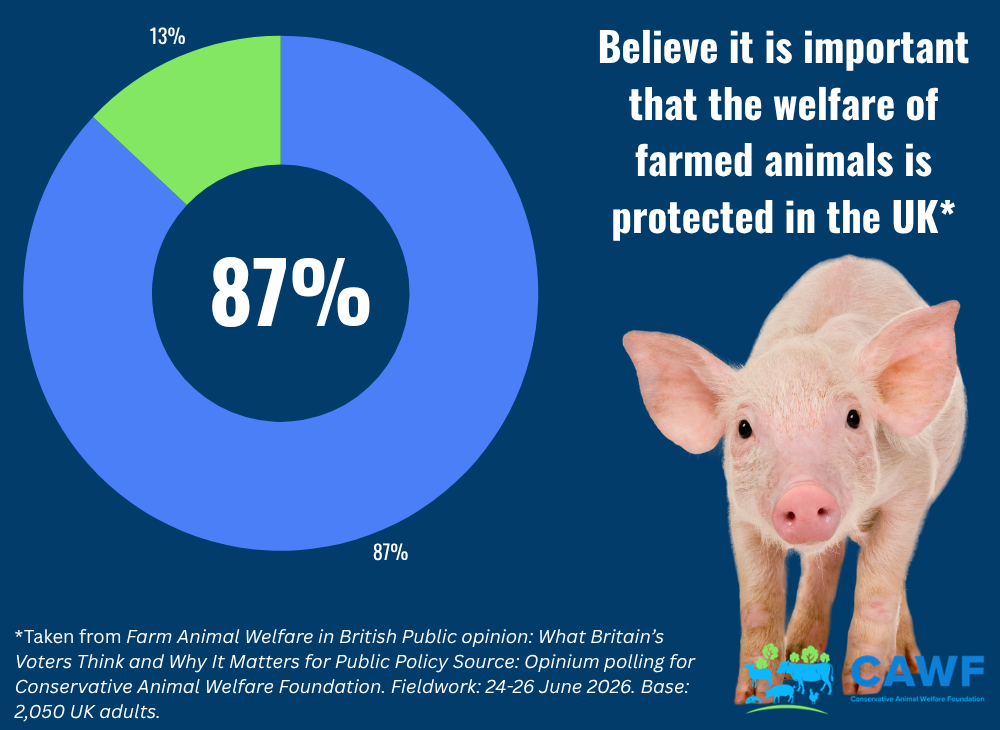
The concern extends much further than that core group. Eighty-seven per cent of respondents said it is important that the welfare of farmed animals is protected in the UK.
An issue that crosses political divides
Perhaps the clearest message from the polling is that this is not a concern belonging to one party or one section of the electorate.
The proportion saying that protecting farmed animals is important was 89 per cent among Conservative voters, 88 per cent among Labour voters, 85 per cent among Liberal Democrats, 88 per cent among Reform UK voters, 90 per cent among Green voters and 91 per cent among Restore Britain UK voters.
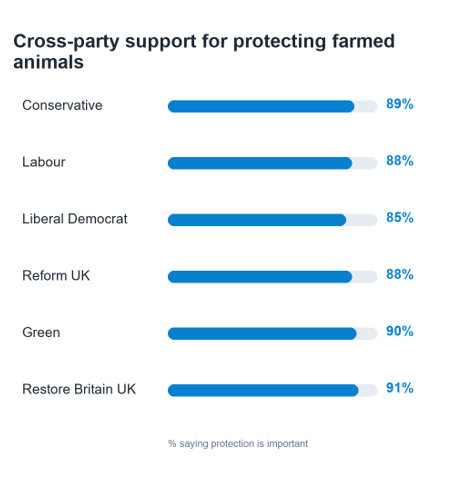
In an increasingly divided political climate, that degree of agreement is unusual. It should also challenge the assumption that farm animal welfare is essentially a concern of the political left. Conservative and Reform voters care about it just as strongly.
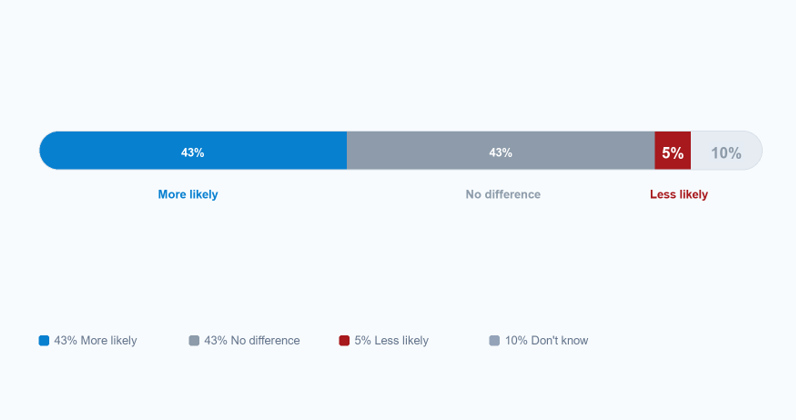
The political significance is equally clear. Asked whether a commitment to advancing farm animal welfare would affect their voting support, 43 per cent said they would be more likely to support such a party. Only 5 per cent said they would be less likely, while 43 per cent said it would make no difference.
Support for practical reform
The public response is strongest when proposals are clear and workable. Seventy per cent supported stronger UK laws to improve farm animal welfare, with only 4 per cent opposed. Seventy-six per cent backed mandatory welfare labelling showing the conditions in which animals were reared, and 69 per cent supported clear labelling of food produced through religious non-stun slaughter.
Even restricting imports produced below UK welfare standards attracted 52 per cent support, against 18 per cent opposition. People understand the basic unfairness of asking British farmers to meet higher standards while allowing those standards to be undercut by lower-welfare products from abroad.
The findings on farrowing crates are especially revealing. Fifty-five per cent had not heard of the cages before taking part in the survey. After reading a factual explanation, 51 per cent said the law should prohibit their use for any period. A further 57 per cent supported a complete ban on cages for farmed animals.
This is important because it shows what can happen when people are given straightforward information about an intensive farming practice. Awareness leads to understanding, and understanding allows people to form a considered judgement.
The public also takes a practical view of how higher standards should be funded. Respondents did not place the burden mainly on individual farmers or consumers. Retailers and supermarkets were selected most often as the main source of support, followed by Government. At the same time, majorities said they would be willing to pay more for higher-welfare meat, eggs and dairy products.
The leader makes policy matter
Our opinion piece published in the Daily Express argues that British politics has become increasingly presidential. Voters do not judge parties only by individual policies; they form a broader view of the leader’s personality, strength, judgement and sense of direction.
This polling puts substance behind that argument. A leader who advances credible animal welfare reform will be responding not to a narrow campaign constituency, but to a mainstream concern shared across the electorate. The public wants practical measures that protect animals, inform consumers, uphold British standards and share costs fairly.
The public has made its view clear. Protecting farmed animals matters. Political leaders should now show that it matters to them too.