Lorraine Platt Co-Founder CAWF
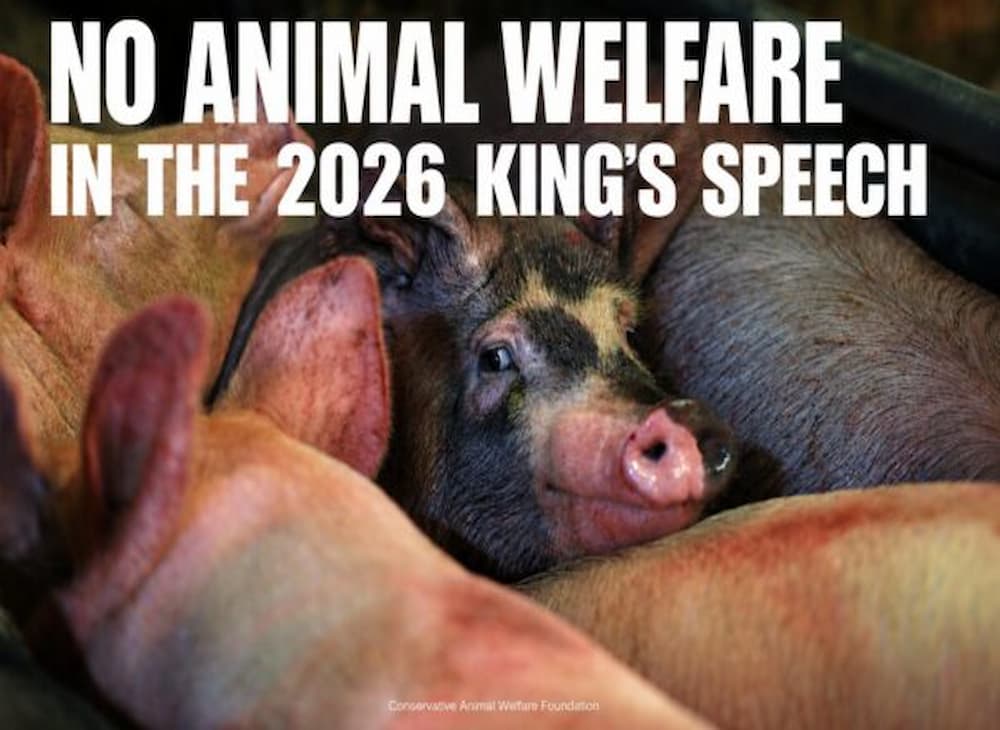
The King’s Speech is more than ceremony. It is the government’s public declaration of priorities and a clear signal to Parliament, campaigners, businesses, and the public about what matters enough to shape the legislative agenda for the year ahead. That is why the absence of animal welfare measures from this year’s King’s Speech matters so deeply.
For millions of people across the UK, animal welfare is not a fringe issue. It is a moral issue, a public health issue, an environmental issue, and increasingly a political one. Poll after poll shows strong public support for stronger protections for farm animals, wildlife, companion animals, and animals used in trade and entertainment. Yet despite repeated promises over almost two years, animal welfare has once again slipped down the political agenda. That should concern everyone, not just animal advocates.
A Broken Promise to Animals
The government recently published the Animal Welfare Strategy, which announced ambitious commitments. Ministers gave speeches about delivering the biggest boost for animals in a generation. But speeches are easy- legislation is harder.
The omission of any animal welfare measures from the King’s Speech suggests that many of those commitments are now stalled, delayed, or quietly abandoned. Issues that campaigners and the public were led to believe would be addressed remain unresolved.
These include ending foie gras imports, reforming animal testing, ending the use of cages and pig farrowing crates, introducing stronger protections for farmed fish, ending trophy hunting imports, implementing the Animals (Low Welfare Activities Abroad) Act, introducing a close season for hares, banning snaring, and improving wildlife crime enforcement.
These are not abstract policy debates. They involve real suffering experienced by millions of animals every year. When legislation fails to appear, that suffering continues.
What the Silence Really Signals
Politics is about priorities. Governments include in major legislative programmes the things they care about most. When something is absent, it sends a message. The absence of animal welfare from the King’s Speech risks signalling that it is no longer a current priority for the government.
This matters because momentum is fragile. Campaigns that take years to build can quickly lose ground when governments stop treating welfare reform as urgent. It also matters internationally. The UK has long positioned itself as a global leader on animal welfare, but leadership is not maintained through rhetoric alone. Other countries are moving forward with stronger laws and higher standards. If Britain stalls, it risks losing both moral authority and global influence.
One of the most persistent misconceptions in politics is that animal welfare becomes less important during periods of economic pressure. In reality, the opposite is true. Animal welfare is deeply connected to many of the biggest challenges society faces; intensive factory farming affects public health and disease risk, wildlife decline affects ecosystems and food security, poor regulation damages consumer trust, the illegal animal trade fuels organised crime, and industrial farming systems contribute to environmental degradation, including river and air pollution.
Compassion and practicality are not opposites. Higher animal welfare often aligns with better food systems, healthier environments, and higher public standards. This is why public concern remains high even during difficult economic times. People do not stop caring about cruelty simply because budgets are tight.
The Public Is Often Ahead of Politics
Perhaps the most striking aspect of this omission is how out of step it feels with public opinion. British people consistently support stronger protections for animals. Consumers increasingly care about where their food comes from and how animals are treated. Younger generations in particular see animal welfare as part of a broader ethical conversation about sustainability, justice, and responsibility.
Animal welfare is no longer a niche campaign area driven solely by activists. It cuts across political divides, age groups, and regions. Rural and urban voters alike care about cruelty, standards, and fairness. When governments fail to act, they are not ignoring a minority interest – they are ignoring a widely shared national value.
The Omission Is a Wake-Up Call
The omission from the King’s Speech is disappointing. But it should also act as a wake-up call. Progress on animal welfare has never happened automatically. Every major reform — from the Ivory Act to the ban on live exports — happened because campaigners, charities, scientists, journalists, politicians and ordinary members of the public refused to let the issue disappear.
Political attention follows public pressure. Now is not the moment for silence or resignation. It is the moment to demand clarity: Which previous commitments remain government policy? Which reforms have been delayed? What timetable exists for action? And how will ministers uphold claims of global leadership without legislation?
We will continue to speak out and campaign for the government to act upon its pledges to deliver ‘the biggest boost to animal welfare’ in a generation and to introduce a government Bill to achieve this. Governments may choose not to include animal welfare in a speech. But the public does not have to accept its exclusion from the national conversation.
Animals Cannot Afford to Wait
The central issue is simple: every delay has consequences. While legislation stalls, animals continue to suffer in systems the public increasingly rejects. Every postponed reform means another year of avoidable cruelty continuing behind closed doors.
The King’s Speech may have omitted animal welfare. But that omission should not be mistaken for irrelevance. If anything, it reveals exactly why continued pressure is necessary. Because animals have no political voice of their own. And when governments stop speaking about welfare, it becomes even more important that the rest of us do.