Britain’s Food System Faces “Double Vulnerability” as Food Sovereignty and Food Security Risks Grow, New CAWF Report Finds: Report who owns British Farming
The Conservative Animal Welfare Foundation (CAWF) has released new research warning that the UK’s food system is increasingly exposed to global shocks, with control over production and supply steadily shifting beyond British borders.
The report,’ Who Owns British Farming? Vulnerability in the UK Food System’, finds that the UK is facing a “double vulnerability”: a growing reliance on foreign corporate ownership within its domestic agricultural sector- undermining food sovereignty -alongside a deep structural dependence on overseas land to sustain current consumption patterns- weakening food security.

Despite devoting 69% of its land to agriculture, the UK’s food system is increasingly defined by a loss of control. As small family farms give way to intensive factory farms, Britain’s dependence on imported food persists.
The report’s analysis reveals that the UK has increasingly outsourced both the control and resilience of its food system.
Loss of Control Over British Farming
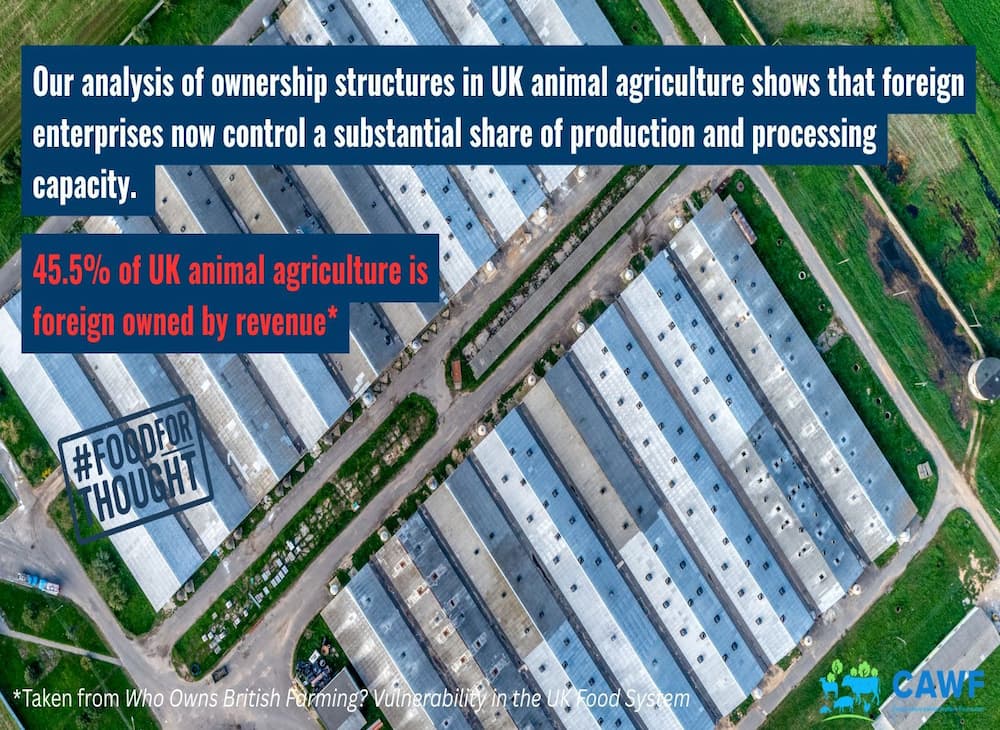
CAWF’s analysis shows that foreign entities now control approximately 45.5% of the UK’s own animal agriculture production and processing by revenue, with even higher levels in key sectors including dairy (64%), pork (52%) and beef (45%).

This means that strategic decisions over investment, pricing and supply for nearly half the animal-based food market are taken by boards sitting outside the UK.
In effect, the UK has relinquished control to international, profit-driven enterprises and therefore jeopardised Britain’s food sovereignty.

Moreover, the extent of foreign ownership suggests that at least some of the profits from the rural economy are flowing to parent companies outside the country.
In practice, British consumers and policymakers have diminishing influence over how food is produced, distributed and prioritised.

Dependence on Overseas Land
Alongside this loss of control, the UK is heavily dependent on land abroad to sustain its current diet.
The report shows that the UK’s reliance on livestock creates a physical dependency on foreign resources. To maintain current consumption patterns, the UK requires approximately 15.4 million hectares of overseas land—an area larger than England and Wales combined.
This footprint is highly concentrated geographically, with 43% of that land located in Ireland and the vast majority of all overseas agricultural land tied to cattle and dairy supply chains (75%)
This creates dangerous “chokepoints”, exposing UK consumers to disruption from climate shocks, trade disputes and geopolitical friction in a small number of partner countries. Should Britain’s key trade partners be unable or unwilling to supply, the resilience of the UK food system collapses.
A System That Combines Risk with Weak Returns
The report argues that the current model represents a “worst-of-both-worlds” scenario: the UK bears the environmental and welfare costs of intensive farming, while at least some of the profits flow overseas and food security relies on foreign land.
At the same time, this system fails to deliver on the core promise of cheap food, as the country is continuously left vulnerable to global food price surges.

A Strategic Opportunity for Reform
CAWF is calling for a strategic rebalancing of the UK food system to strengthen both food security and food sovereignty.
The report highlights the potential to:
• Prioritise British agriculture while reducing dependence on overseas land and shifting national priorities towards domestic horticulture and more efficient land use
• Improve national self-sufficiency, particularly in fruit and vegetables, where current levels remain low
• Retain more value within the UK rural economy rather than exporting profits to multinational corporations
• Support a transition towards more sustainable and resilient farming systems
CAWF also points to international examples, including the Netherlands’ high-output horticulture sector, as evidence that land-efficient, domestically focused production can deliver both economic and food security benefits.
Commenting on the report, co-founder Chris Platt said:
“Britain’s food system is often presented as secure because of high domestic production. Our findings challenge that assumption.
“In reality, control over a significant share of British farming now sits overseas, while the system itself depends heavily on land and inputs beyond our borders.
“This creates a double vulnerability, undermining both our food sovereignty and our food security.
“In an increasingly volatile world, this creates clear strategic risks. Food security is not just about how much we produce—it is about who controls that production and where its foundations lie.
“This report highlights the need for a more resilient, sovereign and forward-looking approach to British agriculture—one that supports farmers, strengthens domestic production, and reduces exposure to global shocks.”

ENDS
Notes to Editors:
• The report Who Owns British Farming? Vulnerability in the UK Food System is published by the Conservative Animal Welfare Foundation
• The analysis combines industry revenue data with land-use modelling to assess ownership structures and overseas land dependencies
• Key findings include:
o 45.5% of UK animal agriculture is foreign owned by revenue
o 15.4 million hectares of overseas land are required to sustain UK consumption – an area larger than England and Wales combined
o 75% of overseas land use is tied to cattle and dairy supply chains