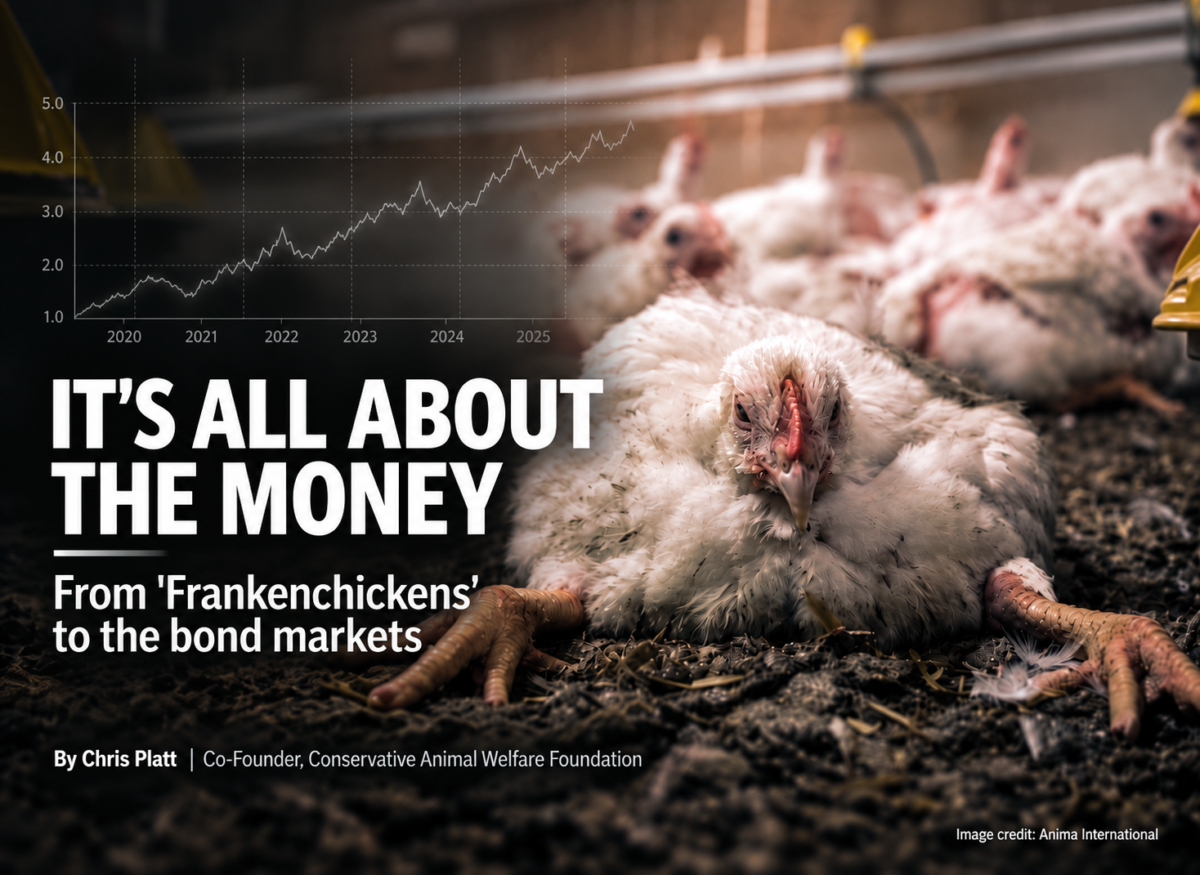
From ‘Frankenchickens’ to the bond markets
By Chris Platt | Co-Founder, Conservative Animal Welfare Foundation
This article is for general information only and is not intended to constitute investment advice.
Factory farming depends on finance. To end practices such as breeding ‘Frankenchickens’, we must show companies and investors why poor animal welfare is also a financial risk.
‘Frankenchickens’ and the business behind them
The term ‘Frankenchickens’ describes chickens bred to grow exceptionally quickly. Research comparing commercial broiler breeds has found that slower-growing birds are healthier and show more behaviours associated with positive welfare.
Behind the welfare issue is a capital-intensive system of breeding programmes, hatcheries, feed mills, poultry houses, processing plants and distribution. Bonds, loans and repeated refinancing support the balance sheets of companies across that chain. A bond may never say ‘Frankenchickens’, but finance helps sustain the system that produces them.
The campaign cannot stop at showing what happens to the chicken. It must also show what happens to the business when customers demand better welfare, buyers change sourcing requirements, courts impose liability or governments change the law.
What companies tell their investors
These risks are not simply campaigners’ arguments. Large listed companies are required to disclose material risks to investors. One major food producer’s 2025 regulatory filing identifies animal disease, changing consumer preferences, regulation, litigation, debt, capital-market volatility and changes in credit ratings among the risks that could affect its business. It warns that a ratings downgrade could restrict access to capital and increase borrowing costs.
The same filing says financial success depends on anticipating consumer preferences and protecting its brands. It describes advertising, promotions and public relations, alongside growing reliance on social media. It warns that negative online commentary can damage reputation and that failure to maintain brand image can harm sales and financial performance. These are the company’s own warnings to investors. Protecting a brand is not the same as improving animal welfare.
The filing also describes an integrated chicken business, including breeding-stock operations, while commercial breeding programmes are marketed on feed efficiency, growth and lower production costs. The connection between production choices and the balance sheet is already there. The task is to show how their welfare consequences can become financial costs.
‘What will the bond markets say?’
When a government makes an unexpected Budget commitment, the familiar question is: ‘What will the bond markets say?’ The principle is simple. If investors see more risk, they demand a higher return. Companies face the same test when they issue bonds or refinance debt.
A corporate bond is a tradable loan. Investors provide money for a fixed period; the company pays a fixed or floating rate of interest and eventually repays the debt. With a fixed-rate bond, the issuer’s coupon does not change simply because investors become more worried about the company. The market price of the bond can change, however, and that matters.
Suppose a bond is due to be repaid at 100 but begins trading at 90. A new buyer still receives the existing coupon and, if the company repays the bond in full, also receives the difference between 90 and 100 at maturity. The return available to that buyer is therefore higher than the coupon alone. In bond-market language, the yield has risen as the price has fallen.
The financial consequences of welfare-related risk do not wait until a bond matures. Existing bonds trade every day, and investors continually reassess the business. If regulation, customer pressure, litigation, reputational damage or changing market access make a company appear riskier, its bonds can trade at lower prices and higher yields.
Not every fall in a bond price is company-specific: wider interest rates move prices too. Analysts therefore compare a company’s yield with comparable debt and government bonds. A wider credit spread signals that investors require more compensation for taking that company’s risk.
The company does not immediately pay more interest on an existing fixed-rate bond. But if its debt consistently trades at higher yields, that signal can feed into the next bond issue, bank negotiations and refinancing. For the animal-welfare movement, this is the crucial point: translating welfare evidence into financial risk can matter every day, not just when a bond is repaid.
The bond does not say ‘factory farm’
Conventional bond documents rarely say that the money will pay for a particular pig farm, poultry complex or slaughter line. They usually refer to ‘general corporate purposes’, acquisitions or refinancing. That broad wording matters because the finance supports the company as a whole.
One public notice from 2023 shows the scale and length of this finance. Subsidiaries of a major global food producer issued $1.6 billion of notes due in 2034 and $900 million due in 2053. The proceeds were to repay shorter-term debt and support general corporate purposes.
We cannot trace those particular dollars to one farm or practice. But investors are financing the balance sheet of the business that operates the system, and the maturity dates matter. Animal-welfare regulation can change within a few years while a bond may remain outstanding for decades. New rules can require changes to production, affect market access or alter the value of existing facilities long before repayment is due.
That can weaken profits and cash flow, increase credit risk, reduce a bond’s market value and make future refinancing more expensive. A bond due in 2053 therefore cannot be assessed against today’s rules alone. Investors need to consider how quickly welfare standards could change, what adaptation would cost and whether the business can still pay interest and repay its debt.
This work has already begun
The financial sector is not starting from zero. Organisations including the FAIRR Initiative, the Business Benchmark on Farm Animal Welfare and the FARMS Initiative have helped investors and financial institutions recognise animal welfare as a material business and investment risk. Some investors already incorporate welfare considerations into ESG – environmental, social and governance – policies, due diligence, investment analysis and engagement.
That work matters and should be acknowledged. The opportunity now is to take it further into mainstream credit analysis: translating welfare-related risks more consistently into their potential effects on cash flow, asset values, market access, credit quality, bond pricing and the cost of refinancing. The movement does not need to invent a new risk category. It needs to provide evidence that allows existing risks to be assessed and priced more fully.
How welfare becomes corporate risk
The animal-welfare movement does not lack evidence. We know what fast growth can do to chickens, what confinement means for sows and where poor practice occurs. The gap is translation. Welfare harm can lead to lost contracts, tighter regulation, restricted market access, higher costs, stranded assets or less dependable cash flow. That is when a welfare issue becomes a financial issue.
The UK Better Chicken Commitment shows how the ‘Frankenchickens’ issue can reach the balance sheet. Its sourcing requirements cover breed, stocking density, housing, stunning, auditing and annual reporting. Meeting higher standards can require new suppliers, changes to production and capital spending. Delaying change can also bring commercial and reputational costs.
California’s Proposition 12 shows how quickly welfare concerns can become hard commercial constraints. Voters approved the measure in 2018, restricting the sale of pork unless breeding sows were housed to prescribed standards. When the US Supreme Court upheld the law in 2023, producers had argued that compliance would require capital expenditure and raise production costs. Within five years, a welfare proposal had become a legal condition of market access – well within the life of a long-dated bond.
Why refinancing matters
Had the animal-welfare movement developed this financial approach more systematically twenty years ago, much of the debt now sitting on corporate balance sheets would have been refinanced several times, creating repeated opportunities for welfare-related risks to be reflected more fully in lending decisions and borrowing costs.
The sums can be significant. As an illustration, a one-percentage-point increase in borrowing costs, once reflected across the current borrowings of two major global meat producers, would amount to around $290 million a year in additional interest. This is not a forecast that animal welfare will add one percentage point to borrowing costs; it simply shows how a relatively small change in the cost of capital becomes material when applied to very large debt balances.
The movement can provide the evidence investors and lenders need to assess regulatory, customer, litigation and market-access risks. Evidence that changes an analyst’s view of future cash flow, assets or market access can contribute to that assessment. Over time, sustained attention to the corporate cost of poor welfare can make ending these practices the more economical choice.
Follow the money beyond the banks
Banks are the most visible part of the financing chain. They lend directly and arrange bond issues. But the money used to buy those bonds often comes from pension schemes, insurers and investment funds – ultimately, from ordinary savers. A workplace pension can therefore hold the debt of a factory-farming business without the saver ever knowing.
That changes where campaigners should look. The bank that arranged a bond may not own it for long. We need to understand which funds hold the debt, what their rules permit and what their analysts assume about welfare-related risk. The aim is not to identify a single villain. It is to find where material risk is being underestimated or insufficiently priced.
Are we still talking mainly to ourselves?
The animal protection movement is effective at speaking to people who already care. The harder question is whether we are reaching the wider public. In 2024, one of the animal-welfare movement’s leading advocates noted that global online search interest in ‘intensive animal farming’, including searches such as ‘factory farming’, had remained broadly flat relative to all searches over roughly two decades. The same commentary cited analysis showing that English-language news coverage of factory farming had grown only in line with general agricultural reporting since 2010, while climate coverage had grown two to three times faster.
CAWF’s 2026 national polling makes the gap more concrete. Of 2,050 UK adults, 55.1 per cent had never heard of farrowing crates. More than half the public was unfamiliar with one of the movement’s longest-running farm-animal welfare concerns.
The term ‘Frankenchickens’ shows the value of language people can remember. But public communication is only one half of the task. Campaigns create political and consumer pressure; financial analysis shows companies and investors what that pressure can cost.
What should happen next
The next step is to translate welfare evidence into the forms of corporate risk that companies and investors already recognise. That means working not only with campaigners and welfare scientists, but with bond and credit analysts, former fund managers, accountants, corporate lawyers, economists, data analysts and commercial communicators.
Large agribusinesses already employ investment banks, lawyers, accountants, credit advisers, public-affairs firms and communications specialists to protect their interests. The animal-welfare movement needs comparable professional range. The question is not whether an analyst shares our moral view. It is whether that analyst can demonstrate that a welfare-related risk has been overlooked, underestimated or mispriced.
Finance will never replace the moral case, nor should it. But factory farming depends on capital. If poor welfare is translated more consistently into regulatory, customer, litigation, asset and market-access risk, those consequences can feed into forecasts, secondary-market bond prices, credit assessments, borrowing costs and investment decisions.
Our objective should be clear: translate poor welfare into material corporate risk until continuing these practices means escalating commercial and financing costs, restricted access to capital and, ultimately, the risk of financial failure. The animal-welfare movement has the evidence. We now need to turn it into a financial case that makes ending these practices the financially rational decision.
References available on request.